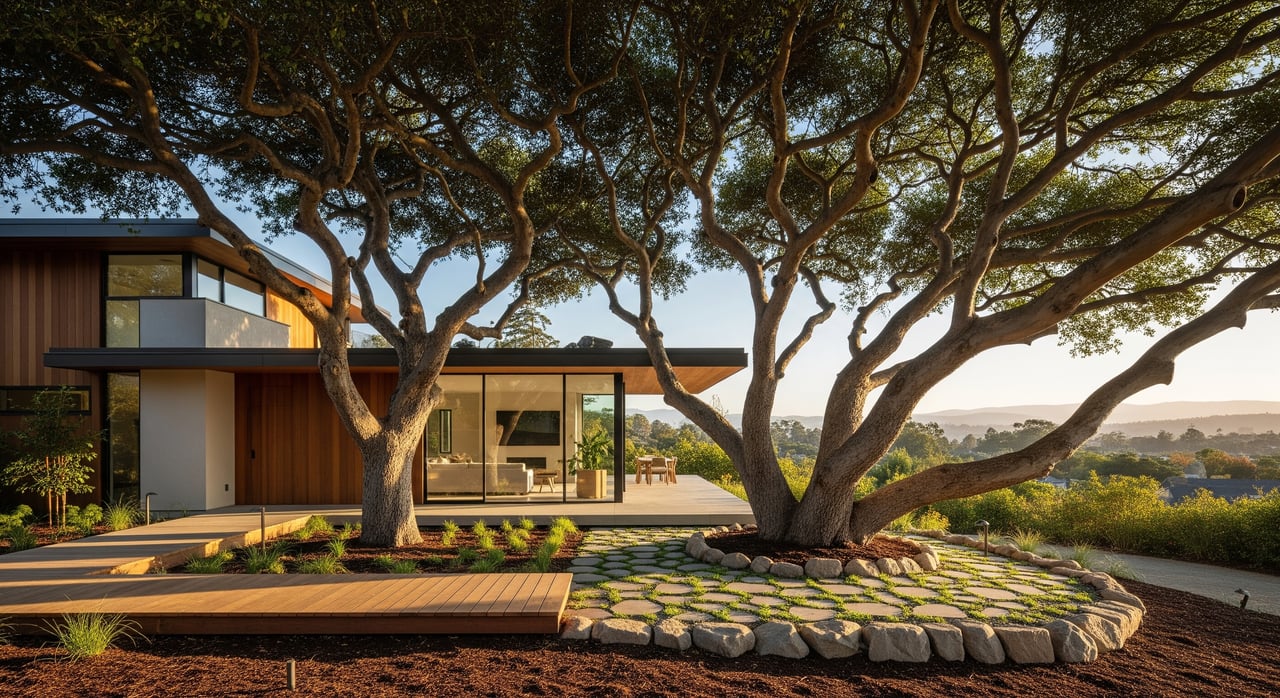
Remodeling in San Carlos and realizing a mature oak sits where you hoped to add a bedroom or a new driveway? You are not alone. San Carlos protects many trees, and those rules can shape where and how you build. In this guide, you will learn what counts as a protected tree, how Tree Protection Zones work, smart design workarounds, and what to expect from permits, fees, and timelines. Let’s dive in.
What counts as protected
San Carlos treats “protected trees” broadly. It includes significant and heritage trees, trees required by approved plans, and trees within communities of trees. Several species are explicitly exempt, including eucalyptus, Monterey pine, Tree of Heaven, acacias, and most fruit trees. You can review the City’s definitions and exemptions in the municipal code. See the San Carlos Municipal Code guidance on protected trees and exemptions.
Protection also depends on size. The City uses species-specific circumference thresholds measured at 48 inches above grade. The official application includes a “Protected Tree Thresholds” table that shows when a permit is required. Check your tree’s species and measurement against that table before you design. Review the City’s protected-tree application and thresholds table.
How rules shape design
Map the TPZ early
Expect a Tree Protection Zone, or TPZ, around any protected tree. The baseline TPZ is a radius equal to ten times the trunk diameter measured at 54 inches above grade. The City Arborist can adjust this based on species, age, soil, and proposed work. See the TPZ requirements in the municipal code.
Know TPZ limits
Inside a TPZ, you cannot store materials or chemicals, compact soil, or trench without approval and arborist oversight. Concrete or asphalt over an oak’s TPZ is not allowed unless the City Arborist approves it. Protective fencing, ground protection, and monitoring are standard conditions. These measures keep roots healthy and reduce long-term risk to the tree and your project.
Expect arborist oversight
San Carlos relies on an ISA-certified arborist for protection plans and inspections. The City may require arborist reports, set construction conditions, and schedule inspections before, during, and after critical work. You will submit plans that show trees and TPZs with your application. Use the City’s protected-tree application checklist to prepare.
Smart design strategies
Plan and document early
Start with a tree inventory. Map species, circumference, and canopy, and mark likely protected trees on your site plan. Building your design around confirmed TPZs will save time, redesigns, and fees. The City’s thresholds table and an early arborist consult are invaluable.
Shift footprints and access
Whenever possible, place the building envelope, driveway, patios, and utilities outside the TPZ. On tighter lots, consider sliding the footprint, flipping the garage location, or adjusting entry paths. Thinking “around” a healthy specimen tree usually beats trying to go “through” it.
Use low-impact foundations
If you must build near a protected tree, consider minimal-disturbance systems that bridge root zones. Options include deep piles or piers with grade beams, pier-and-beam with cantilevered elements, or a raft slab designed by a structural engineer working with your arborist. These approaches reduce wide, shallow excavations that cut major roots. Explore industry guidance on building near trees.
Where clay soils and moisture change are factors, coordinate with a soils engineer and your arborist. Roots influence moisture and seasonal movement, so foundation design and irrigation planning should work together. Learn how roots and soil moisture interact near construction.
Reroute utilities and paving
Avoid trenching within the TPZ. If you cannot avoid it, use directional boring or careful hand-digging under arborist supervision, then backfill promptly and protect exposed roots. See best practices for protecting trees during utility work.
For drives and walkways near roots, consider permeable or “no-dig” assemblies with geogrids or cellular confinement instead of compacted base and asphalt. Remember, concrete or asphalt over an oak’s TPZ needs City Arborist approval under the code.
Follow pruning rules
San Carlos defines “trimming” as removing less than 25 percent of the crown or root system. Trimming does not require a protected-tree permit. “Pruning” over 25 percent does require a permit, and any destructive root work should be performed or supervised by an ISA-certified arborist using clean cuts to reduce decay risk.
Protect and monitor
Install rigid TPZ fencing before site work, add 4 to 6 inches of mulch within the fence, and use ground-protection mats for any necessary crossing. Schedule arborist check-ins at key milestones. These steps align with City expectations and national best practices. Read practical guidance on protecting trees during construction.
If removal is unavoidable
San Carlos approves removals only for good cause. Examples include a dead tree, a high or extreme ISA tree-risk rating, an incurable disease, a species the City deems low desirability, or an unavoidable conflict with essential development when no reasonable alternative exists. Applicants must show why design alternatives do not work. Review removal criteria in the municipal code.
If a removal is approved, expect replacement trees or in-lieu fees. The City specifies allowed species and planting conditions, and it prohibits certain species as replacements. Moving a protected tree on site is treated as a removal and requires documentation to prove survivability under accepted standards.
Permits, fees, timing
Apply using the Protected Tree Removal and Pruning Application. You will provide the form, a Statement of Reasons, an Arborist Inspection Consent form, a site plan showing trees and TPZs, and photos. You can submit by upload or mail through the Planning Division. Start with the City’s application package.
Plan for a $210 processing fee plus a removal-permit deposit. The application notes deposits that often start around $500 and can range to $600–$1,500 or more depending on review needs. After filing, expect a City Arborist site visit and a written status update in about 3 to 4 weeks. For development or utility-related removals, the City mails notice within 300 feet and requires on-site posting for roughly 10 to 14 days. Decisions can be appealed to the Planning Commission, typically within 10 days.
In an emergency hazard, the City may grant oral permission for removal, but an after-the-fact permit and replacement may still be required. Removing or pruning a protected tree without a permit can trigger doubled fees, an arborist appraisal, civil penalties, and a stop-work order. Fines can reach up to 5,000 dollars per tree or the appraised value, whichever is higher. See penalties and enforcement in the municipal code.
Budget and timeline tips
- Bring an ISA-certified arborist onto the team during concept design to set realistic TPZs and workarounds. Early clarity reduces redesigns and review cycles.
- Price for alternatives like pier-and-beam foundations, directional boring, and no-dig paving. These add cost but often prevent delays and denials.
- Include protection fencing, ground protection, and monitoring visits in your baseline budget and schedule.
- If removal might be necessary, build time for noticing, potential appeals, and replacement planting into your plan.
Quick project checklist
- Inventory trees and measure circumference at 48 inches. Cross-check species against City exemptions and the thresholds table.
- Map TPZs and show fencing, staging, and no-go areas on plans.
- If work enters a TPZ, include an arborist-prepared Tree Protection Plan and inspection schedule.
- Evaluate foundation and utility alternatives. Document why removal is not feasible if you are seeking a removal permit.
- Install TPZ fencing before site work. Prohibit storage, parking, and chemical use inside the fence.
- If removal is approved, budget for replacements or in-lieu fees and follow the City’s species list.
- After construction, follow the arborist’s care plan for 1 to 3 years to support tree recovery.
Protecting trees is good for your property value and your project timeline when you plan ahead. If you are weighing design options or a permit strategy in San Carlos, let’s talk through the best path. For clear, local guidance that aligns your remodel plans with the City’s rules, connect with Daniel Fridman. Hablamos español.
FAQs
What is a protected tree in San Carlos?
- A protected tree can be a significant or heritage tree, a tree required by approved plans, or a tree within a community of trees, with several species explicitly exempt under the City code.
How is the TPZ calculated in San Carlos?
- The default Tree Protection Zone is a radius equal to ten times the trunk diameter measured at 54 inches, adjustable by the City Arborist based on site factors.
Do I need a permit to prune a protected tree?
- Trimming under 25 percent of the crown or root system does not require a protected-tree permit, but pruning over 25 percent does and should involve an ISA-certified arborist.
Can I pave a driveway near an oak’s TPZ?
- Paving over an oak’s TPZ is restricted and requires City Arborist approval, so consider no-dig or permeable alternatives outside the TPZ when possible.
What are typical permit fees and timelines?
- Expect a $210 processing fee plus a deposit that often starts around $500, with City review and a status update in roughly 3 to 4 weeks after filing.
What happens if I remove a protected tree without a permit?
- The City can require an after-the-fact permit, doubled fees, an arborist appraisal, civil penalties up to 5,000 dollars per tree or the appraised value, and may issue a stop-work order.